More ID cards idiocy. Now we are apparently to get a compulsory card scheme by 2008; this is apparently inspired by warnings from the security services: (reported in a story in the Independent and elsewhere)
Ministers were told that in several recent arrests, police found people with papers giving them multiple identities, and the politicians stressed the importance of making sure the ID cards could not be forged.
- The cards will be forgeable -- it simply isn't possible to make an unforgeable card.
- If everyone is to have a card then they'll have to get them by using existing identity documents. People who already have identity documents for multiple identities will be able to get multiple identity cards.
The proponents of the scheme counter the second of these with the fiction that biometric information can be used to ensure that only one card is issued to each person. This won't work, because the false positive rates for identification by biometrics are too large.
Suppose that the comparison of (say) iris photographs is 99.99% accurate: that is, when you compare my iris photograph against my reference photograph, the system identifies me correctly in 9,999 out of 10,000 cases, and says it's not me one time in 10,000. Similarly, when you compare my iris photograph against someone else's, 9,999 times out of 10,000, it says it's not me, and one time out of 10,000 it says it is me.
Now suppose that I go down to ID Cards 'R' Us (proprietor: Capita plc., most likely) to get an ID card. My iris is photographed, and to ensure that I'm not a Bad Evil Terrorist, my iris photograph is compared against the reference photographs for everyone else in the database (about 40,000,000 people). Even with a 0.01% error rate, the system will come up with 4,000 matches to me -- that's 4,000 people who have to be individually checked to make sure that they're not actually false identities that belong to me.
(Note that in real systems the false accept rate is likely to be different from the false reject rate; it's the false accept rate we care about here.)
Now, according to this report on an iris recognition system tested by the US Department of Defence, the false accept error rate for a typical current system is claimed to be one in a million by its manufacturer, but in practice is probably more like one in 90,000. That gets us down to about 444 people who have to be checked as potential false matches for each ID card issued. If we believe the manufacturer, then it's 40. If you believe that we can afford to investigate in detail the backgrounds of 40 people for each new ID card issued -- which is what will be necessary to ensure that you issue exactly one ID card to each person in the population -- then you're more of an optimist than me. (Optimistically, we can cut out half those matches as being of the wrong gender, and maybe another half as being too different in age to be the same person. But that's still ten people who need to be checked. Doing this properly would be insanely expensive.)
Of course, in reality what will happen is that Crapita (or whatever other contractor puts in the cheapest bid for the system) will hand the sodding things out to all and sundry with no proper checks at all. Sir John Stevens, Commissioner of the Metropolitan Police, yesterday said on TV that,
I think the sooner [ID cards are] brought in the better and as a professional police officer I have to tell you we need them.
If his attitude is typical of the Police (other evidence suggests that many officers are better informed) we're in real trouble, since the result will be that the authorities trust that the ID card system will have its advertised effect -- of making it impossible to adopt a false identity -- while in fact leaving it as easy to create false identities as it ever was, and to have them legitimised by a shiny piece of plastic too.
My sober assessment? We're doomed. All we can hope for is that the terrorists are more incompetent than our government seems to be.
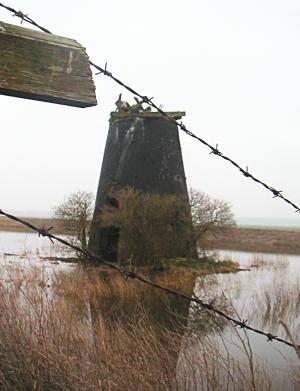
New rule: every time I write a long rant about ID cards, I'll also post another holiday photo for those readers who find ID cards boring (that's probably all six of you, I fear). However, this one is a bit bleak:
Comments
Posted by Anthony, Monday, 5 April 2004 14:56 (link):
Actually Chris, I find your holiday photos boring. More stuff on ID cards! :)
Posted by Nick, Monday, 5 April 2004 15:14 (link):
I like both - but could you give us some descriptions of what the photos are of?
Posted by Chris Lightfoot, Monday, 5 April 2004 15:53 (link):
Goodness. OK. The one above is a ruined windmill (only the tower remains) near Berney Arms in Norfolk (I think it's the one on this map or very close to it). From the previous posting, the four are, in order,
The windmills around the Norfolk Broads are somewhat interesting. They were (I think) all built for drainage, rather than milling grain; the idea was to drain bits of land enough that cattle could graze there. Presumably it remained too wet for arable farming. If you try to drain the land with windmills, you quickly discover an upsetting fact about the English weather: the wind doesn't always blow when it's raining. I don't know how seriously this problem affected the drainage in that part of Norfolk, but in the Cambridgeshire fens things almost came badly unstuck in the nineteenth century, because when you drain a peat fen, the soil shrinks and the ground level drops (as shown dramatically by the Holme Fen Post); though the landowners tried to build windmills to pump water out as fast as they could, sometimes no wind blew and they didn't do any good. Eventually they were saved by the invention of the steam engine. (You might wonder how they managed to drain the land at all without any way to power a pump. Surprisingly enough, that turns out to be easy.)
The windmills seem to have been built over quite a long period, with the later ones being built much more cheaply than the earlier, using a wooden frame rather than a brick tower. There are some pictures on the website of the Norfolk Windmills Trust; the first two at that link (Boardman's and Clayrack) are of the later type. I don't understand why the earlier ones were built so much more expensively. There are a wide variety of styles of building too; the most striking, I think, is the one at St. Benet's Abbey, built in and using materials from, the gatehouse of the ruined abbey.
Posted by Geoff, Monday, 5 April 2004 17:07 (link):
Apparently the pyramids are the same - the earlier ones are a lot better built than later ones. Guess they didnt have ISO9000 quality controls in place
Posted by Chris Lightfoot, Monday, 5 April 2004 15:18 (link):
There's no pleasing some people....
Posted by Anthony, Monday, 5 April 2004 16:39 (link):
Pah! OK - I'll try to be constructive. Did you see the YouGov poll at the weekend, right at the end it asked about ID cards and got (IIRC, because I can't be bothered to look it up again) over 80% support for them. Now that was after a long series of questions about immigration and terrorism and specifically presented ID cards as an anti-terrorist measure so it's clearly not unbiased, but since the Government is going to push ID cards on exactly the same grounds anyway I still think the figure is worth looking at.
For personal (albeit anecdotal) experience, members of what MORI call "the traditional poor" who the the most concerned about immigration, also tend to have a naive belief that ID cards would instantly foil all these evil illegal immigrants (and this is probably not unconnected with Labour's sudden rediscovery of the policy at the same time as Philip Gould is telling Blair that immigration is going to hurst him at the polls).
You need to start banging your drum again for someone to come up with a nice anti-ID cards viral marketing piece written in Daily-Mail-ese
Posted by Chris Lightfoot, Monday, 5 April 2004 17:20 (link):
I saw reports, but didn't look at the actual poll. Now I have -- for reference, the report is here -- and it's bloody frightening. (It would have been interesting to know how many immigrants people believe enter the country each year, too; I suspect that people have no real notion of the figures.) There's some hope, though:
-- suggesting that people aren't happy to pay directly for extra security. So as the price of the proposed ID card system rises, support for it may fall. Of course, since (taking my estimate of £120--400 per person, based on the claimed cost of £40 multiplied by a large factor to take account of cost overruns) the government is never going to actually charge people the full amount `at the point of delivery', they may be able to hide the cost in increases in the general Home Office budget.
It should be easy enough to blow great holes in the ID cards proposals -- all that's needed is for someone to ask Blunkett what the cards will be useful for, and watch him flounder -- but nobody seems to want to. So I suppose viral marketing is the only option. Obviously I need to make time to write the thing....
(As an aside, suppose that Blunkett quits over the current immigration `crisis'. Who do you think would be his replacement?)
Posted by Anthony, Monday, 5 April 2004 22:22 (link):
My guess would be John Reid - having said that, internal Labour Party politics are a thing of mystery to me.
Posted by Edmund von der Burg, Tuesday, 6 April 2004 10:19 (link):
I don't think that people are necessarily pro ID cards - it is more that they are against terrorism. It would be interesting to see what answers questions such as these get:
People may well be saying yes to ID cards because they believe they will work, not because they want them. This is a bit like people taking foul tasting medicine - they hope they will get better.
Posted by James Fairbairn, Monday, 5 April 2004 17:29 (link):
Coming as I do from a background of ignorance, could you please explain to me where I'm going wrong here:
Doesn't this tackle the root of the problem? Surely we can just do a bit of work to the DSS database to make it easy for employers to make sure that their prospective hire is not a 'marked man'?
Certainly this is what happened in Hong Kong when they introduced ID cards; it wasn't that ID cards were unforgeable that slowed economic migration (they aren't), but that it's now a very big risk for the employer to hire someone with no ID card.
Posted by Pete Stevens, Monday, 5 April 2004 18:16 (link):
Mr Lightfoot currently isn't a full time employee. Therefore giving 800 trillion quid to a software consultant is a good value way of tracking him and other undesirable people who might disagree with dictator Blair.
Until they discover he's a software consultant that is, then they might think twice about giving money to software consultants.
Posted by Chris Lightfoot, Monday, 5 April 2004 18:39 (link):
I don't think I'm technically a software consultant, though I did once play one on TV.
Posted by Chris Lightfoot, Monday, 5 April 2004 18:37 (link):
Is there even a DSS database? I thought the DWP already had trouble with duplicate NI numbers. And you don't seem to need an NI number to fill out a tax return....
Increasing penalties for employers hiring illegal immigrants is as you say an obvious and workable solution to that `problem', but since the country's continued economic prosperity relies on immigrant labour, that cure may well be worse than the disease. So long as there are more jobs than people to fill them, we have a choice between high inflation and immigration, and our current government (happily) has chosen the latter.
Posted by James Fairbairn, Monday, 5 April 2004 18:40 (link):
Okay, but wouldn't it be cheaper to tidy up the NI number system than to re-tool every government IT system to support ID cards (leaving aside the cost of implementing and supporting the whole ID card disaster)?
Posted by Chris Lightfoot, Monday, 5 April 2004 19:02 (link):
Well, that might have the even worse consequence of leaving your NI number as a unique identifier which can be used to impersonate you (this seems to be how the US got into its current mess with social security numbers).
I have real trouble with this issue because I simply can't see what's wrong with economic migration. Sure, we should throw people out if we have good reason to believe that they're terrorists or other kinds of criminals or David Blaine or whatever. So far as I'm concerned, everyone else is welcome if they can find a job. (If there genuinely are externality costs to economic immigration -- the evidence I've seen suggests that there aren't -- then we can always charge them an additional `new migrant tax' to cover it.) Under that policy, the government no longer has to worry about `illegal immigrants'; it can just concentrate on making sure that all employees and employers pay their taxes -- which is all we should be caring about anyway.
Of course, the real problem with this is political: how do we sell it? Possible Daily Mail headline: `Blair government to import new taxpayers, cut taxes'?
Posted by Andrew Duffin, Tuesday, 6 April 2004 13:08 (link):
You are all mostly missing the point.
ID cards are nothing to do with identity. They are about surveillance and audit trails.
It doesn't matter a toss who you actually are; what does matter is that everything you do, and everything you buy, and everywhere you go, and every penny you spend (in both senses of the phrase, probably), and everyone you email, and every phone call you make, and every website you visit, and where, when, and how fast you drive, and every other tiny thing about your life, will create a record in the State's database. From there it will be instantly queryable - in any form and combination - by all the agencies and employees of the said State, whether official, unofficial, or secret; plus all their dodgy friends and all the dodgy friends of those dodgy friends. Plus all the equivalent people in the US and all EU countries. And any terrorist with half a brain and a PC. And all Capita's and Oracle's and Sun's support techies anywhere in the world. And lots of other techies too. But not you yourself unless you fall into one of those groups.
The ID card is one of the pillars that will enable this.
That is why Blunkett goes all coy when asked what it's for. The real "benefit" can't be admitted, and the only ones that would sell the idea are too implausible and easily countered.
And THAT is why it's frightening and unacceptable.
But you can't do anything about it. The brief age of democracy is gone.
Posted by Chris Lightfoot, Tuesday, 6 April 2004 13:22 (link):
-- that's something to be afraid of too. All it requires is the unique ID (the `primary key') by which people can be identified. And as you say, the card is a good way to carry that. But there still seem to be people who think the card itself is of some use -- like Sir John Stevens. They need disabusing of this notion.
Posted by Owen, Wednesday, 7 April 2004 10:38 (link):
The apparent failure of the 2001 census to account for a million people (BBC News story) does not inspire confidence in the feasibility of assigning ID cards correctly to everyone in the country. This might be a good point to include in your rabble-rousing leaflet.
Posted by Tim, Thursday, 8 April 2004 14:09 (link):
Yeah, but if you've got nothing to hide, you've got nothing to fear.
GAAAAWD - If I hear anyone else trot out that tired old bullshit, I'll... I'll... terrorise them. Is it just me or does that annoy the hell out of anyone else?
Posted by Michael, Saturday, 17 July 2004 18:56 (link):
Quite. An appropriate follow up may be "Well since you have nothing to hide, you won't mind letting me know where you live then? (National Id will do nicely thank you)."
Post a new comment.
Comments copyright (c) contributors and available under a Creative Commons License. See also the comments policy.