So, on Sunday I went to NotCon, which was a lot of fun. I'll leave it to others to write about the whole event in detail and just focus on one bit of it.
The most inspiring of the talks was from Brewster Kahle, the man behind archive.org; his talk was about the idea of putting all of human knowledge (or at least all the bits which are recorded in any fixed form) online for instant access by anyone, anywhere.
He asked the questions, `should we?', `can we?', `may we?' and `will we?', to which one might imagine the answers are, respectively, `hell yes', `hell yes', `who gives a fuck?' and `let's get on with it'. Sadly, `may we?' -- is it legal to do this? -- is the thorniest of those questions. Even though the vast majority of books which remain in copyright are not and never again will be in print, making money for their authors and publishers, it would be Bad and Wrong to let anybody who doesn't already own a copy read any of them. The answer to the question `who gives a fuck?' is that we all should: our civilisation would be much the poorer if we were to ignore the shining edifice of copyright law merely in order to preserve and disseminate knowledge.
Nevertheless I wish Brewster Kahle and Rick Prelinger luck in their court case intended to let them distribute those millions of out-of-print books. (As an aside, how much fun must it be to sue John Ashcroft?)
Kahle is also behind the Internet Bookmobile. This is one of the coolest things ever. It's a truck with a printer, a binder and a satellite connection to the internet in it; you park it somewhere, and print and bind books. This is apparently simple enough that a child can operate the machinery and each book costs about a dollar. There were some samples handed round at the talk, and they were pretty good -- no worse than the average modern paperback. The Bookmobile will print you any book that archive.org has archived -- so far, only those that are actually out of copyright. But that's still a lot of text.
There was another interesting detail in the talk: Kahle asked libraries whether they'd be interested in printing and giving away books using the same technology. He expected them to complain about the cost, but apparently it costs about $2 to lend a book out, so giving away $1 books looks like a pretty good proposition. As the Economist has pointed out, usage of public libraries is in decline partly because buying books has become much cheaper since libraries were established in the mid-19th century. Something which increases the range of books available at the library at the same time as making libraries cheaper to run would clearly be a Good Thing.
I have to say I found the estimate of $2 per book issued rather surprising. It's not at all clear what the direct costs to the library are for each book issued; some elements are obvious (for instance, replacement of books lost by readers and other costs relating to the stock presumably rise with borrowings), but others aren't. Salaries are paid however many books are borrowed, and similarly for the costs of maintaining buildings.
If you read (say) the `Best Value Performance Plan' (really a big table of statistics about public services) from Cambridgeshire County Council, you'll discover (indicator #115) that the `cost per visit' to public libraries is about £2.70, but I think that's just the total funding for libraries divided by the numbers of visits to them, so it doesn't actually tell us the marginal cost of getting a book out. (You'll also discover that Cambridgeshire's aims for the future include both to,
Increase the number of telephone/fax/electronic contacts with libraries to 122,000.
Maintain at 5.5 the number of visits per head of population to libraries.
-- see page 7 of their `Best Value' report. They've achieved the one, but not the other. I wonder why that could be?)
I also had a look at some data from the NSO's Regional Trends, which in recent years has included information on library resources and use, tabulating numbers of books, numbers of visits and issues and expenditure on libraries in various regions. Approaching this in a fairly naive way, you might conclude that each issue of a book costs about 70 pence: (this excludes data from London, which has much highers costs not covered by the model, and one apparently erroneous data point from eastern England)
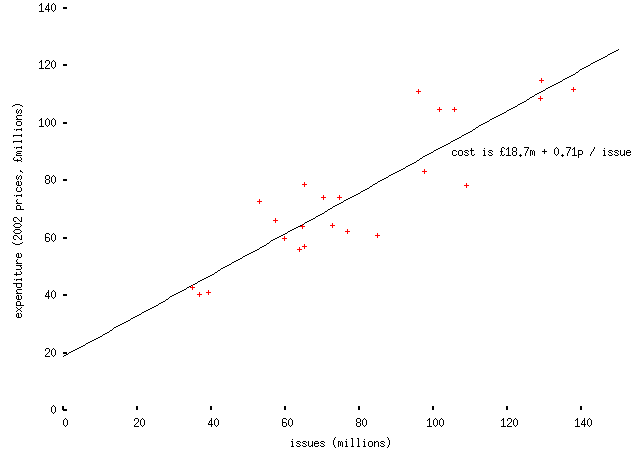
70p isn't quite $2, but isn't a million miles off, either.
However, the above model doesn't actually tell us anything. The NSO give the numbers of visits, books, issues and libraries for each year in addition to expenditure; all of the variables are highly correlated:
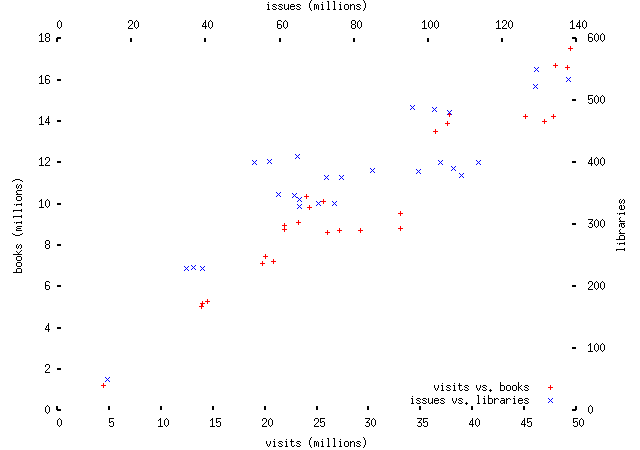
(Obviously the numbers of books issued are closely related by the number of visits to libraries:
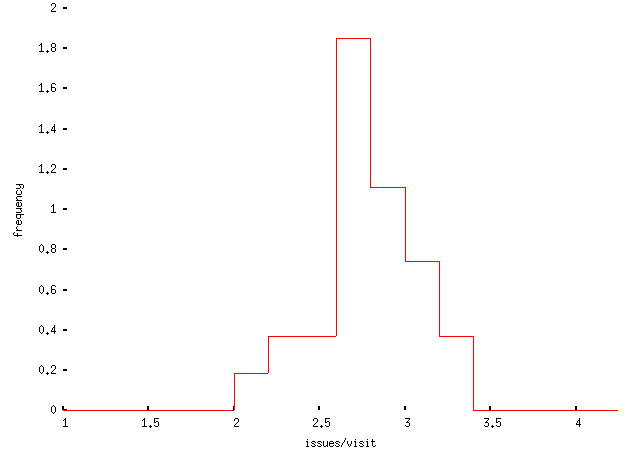
-- the average number of books taken out on a visit to a public library seems to be about 2.8.)
So actually what we've discovered is that regions of the country with more people in them have more libraries which get visited more, lend more books, and cost more. (None of this should surprise us, of course.) There's no real evidence in the above for the cost of lending an individual book.
Another way to look at the data is to look at the expenditure of individual regions from year to year. Unfortunately Regional Trends only seems to have covered this for three years, so it's hard to find anything definite; here's how the expenditure in the different regions (dropping a couple of outliers) changed from 2000 to 2001:
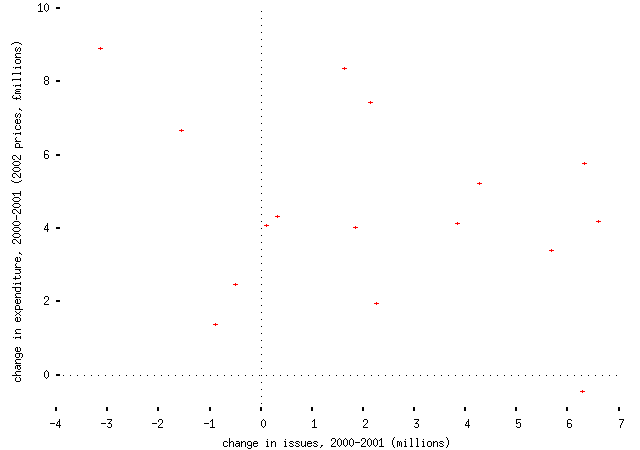
-- I don't think we can safely draw any conclusion from that.
I suspect that Kahle's figure of $2/issue is like Cambridgeshire's figure: providing a decent library service leads to people borrowing a certain number of books (determined by how much people read), and costs a certain amount (determined by how much it costs to buy books, employ staff, build libraries, ...) and one number turns out to be about $2 times the other. If libraries printed free books from the internet for their patrons, then this `cost per issue' might fall -- because people might use the libraries more, they might issue more books, but still cost about the same amount in total. But I don't believe that libraries encounter a direct cost of $2 (or even £2.70 or 70p) for every book they issue.
None of this, of course, affects how we should view Brewster Kahle's efforts. Giving away out-of-copyright (and, let's hope, out-of-print) books for free is a bloody good idea and again I wish him the greatest luck in doing so.