Tony Blair, in his press conference yesterday:
I think ID cards have an important role to play in fighting serious crime and terrorism and tackling illegal immigration.
The Home Office has opinions on serious crime and terrorism too:
Animal rights extremists engaged in these activities [such as harrassment, intimidation, and acts of violence] should not, therefore, be surprised to find themselves treated as terrorists.
And from a BBC News story we discover a shocking abuse of trust:
A vehicle registration official who gave drivers' addresses to animal rights activists has been jailed for five months. [...]
``Dickinson accessed DVLA computer systems to look up people's registration numbers.
``The information he passed on enabled animal rights extremists to identify, intimidate and terrorise the families of people connected to the Hall family and their lawful business at Darley Oaks Farm, Newchurch.''
Whereas David Blunkett, in the House of Commons in July 2002, assured us that:
No one should fear correct identification. There is nothing to fear from the proper acknowledgement and recognition of our identity.
For reference, under the terms of the draft Bill, the planned National Identity Register will, for each person in the country, record:
- their full name;
- other names by which they are or have been known;
- date of birth;
- place of birth;
- gender;
- principal address;
- any other residential addresses;
- a photograph of their head and shoulders;
- their fingerprints;
- `other biometric information';
- various identifying numbers.
Tens of thousands of people -- some of whom will be just as willing to assist terrorists as was Dickinson of the DVLA -- will have access to the database. And with the wonders of modern technology, a copy of the whole thing (excluding the photos) will fit on a single DVD.
Suppose that the Government carry on pissing money down the drain to build this thing, and that they actually finish it. It's harder to think of any better gift for a terrorist organisation intent on intimidating members of the public than a detailed and easily-obtained database of the identity and whereabouts of the entire population of the country. Leaving aside `animal rights' activists, imagine, for instance, the mischief that the IRA could wreak on informants once it has its copy of the Register, or an extremist Christian group on abortionists.
My recommendation? If you do anything, anything at all, whether it is farming guinea-pigs or giving information to the Police, to which some crank or nutcase might object with violence -- you should stop right now. The National Identity Register will make it unsafe for you to continue. Giving in to the terrorists is cowardly, but once they have this kind of advantage, there's not much else you can do.
Meanwhile David Blunkett continues to lose the plot. He has now proposed that,
... from December judges will be expected to reveal if a defendant has prior convictions for the same offence they are charged with.
This sort of nonsense apparently plays well with the public, presumably because most people don't know anyone who has been the victim of a miscarriage of justice and believe -- correctly -- that the chances of their being wrongly convicted are small. (They are small not because the judicial system is perfect but simply because so few people -- guilty or otherwise -- are caught and prosecuted.)
The parallel with ID cards is close. Most of the arguments for the cards are based upon the supposed convenience of carrying and using the card; their proponents forget -- or even, as with David Blunkett and Tony Blair, deny -- that with increased convenience always comes decreased security. It may be all very convenient to flash your ID card and look into the scanner to withdraw money from an ATM, but it'll be less convenient when somebody uses data from the National Identity Register to impersonate you and take all your money -- or to identify you as their terrorist group's persona non grata of the month and blow up your house. Don't worry, you are encouraged to think, it won't happen to you.
Likewise, for those who are not directly affected by them, miscarriages of justice seem remote and many people, I fear, disbelieve the innocence of those who are eventually exonerated; even after the Birmingham Six were finally freed in 1991, it was not uncommon to hear the opinion that they were, nevertheless, `probably guilty' anyway -- this opinion usually being advanced purely on the strength of the victims' Irishness.
On these grounds, arguably what we need is more public awareness -- as a result, presumably, of more miscarriages of justice. And if the government carry on like this, that is exactly what we will get.
And no, I haven't forgotten the ID cards/holiday photos rule:
Comments
Posted by Martin Keegan, Tuesday, 26 October 2004 03:15 (link):
Clearly, if we introduce compulsory ID cards, then The Terrorists Will Have Won. Let us hope the Home Secretary is upright and unswerving in his opposition to this dastardly plan.
Posted by Stretch, Tuesday, 26 October 2004 17:21 (link):
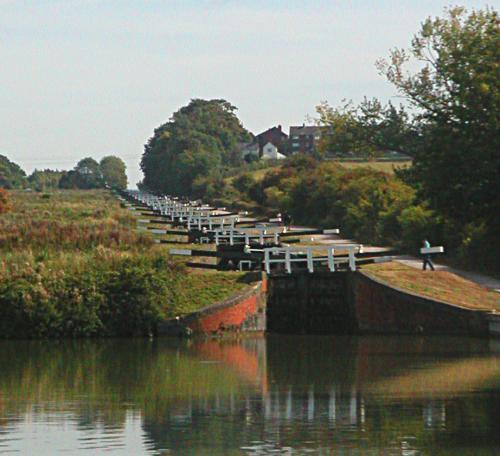
Nice series of locks - where is that?
My crank handle turning muscles ache just looking at it.
On the id cards issue - it is sort of a good idea to register people, and some proof of their existence, address etc. rather than births deaths or marriages, however for the reasons you've outlined the sensible way to do this is with a horrendously old fashioned paper based system, split across regional offices.
Then, for instance, you can get an authorised copy to prove that you're the right person to receive benefits, pay tax on that NI number etc. but anyone wishing to have a quick rifle through a database for their political enemies is given no more advantage than they have at present. I don't know how this could be arranged because the last time I used a card index filing system I wrote a database to replace it after a month.
The problem we currently face is that it is possible to claim just about anything that can be claimed in this country without proving who you are. For example my wife recently gave birth in our local hospital. She's a foreign national. She is actually entitled to the full and excellent healthcare that she received, but it doesn't matter because she was never asked. Not once. They didn't even know her nationality. Free healthcare is a good thing, until people start coming for free "healthcare holidays".
Posted by john b, Tuesday, 26 October 2004 17:55 (link):
Free healthcare is a good thing, until people start coming for free "healthcare holidays".
Is there actually any evidence of this happening, outside of the rantings of old men in pubs? The only people I can think of who'd benefit (= people who can get UK visas easily and don't have a healthcare system at home) would be low-income Americans.
(and given the extent to which we pillage developing countries of doctors and nurses, it might seem reasonable to provide some of their countrymen with medical care...)
Posted by Stretch, Wednesday, 27 October 2004 09:19 (link):
I personally know a few foreign students who've used the health services without entitlement (they thought it was hilarious - I'm inclined to agree, and don't think it makes them BAD PEOPLE - I'd do the same when I travel, if I could). Its one of the reasons that the UK is seen as a land of milk and honey - once you're here everything is available to you.
I agree about the wholesale destruction of other countries health services by poaching staff - its pretty much a criminal way of cutting costs in the NHS so far as I can see.
So far as it looks to me, the whole anxiety about ID cards is on the back of opening our doors to the new member states of the EU - we have a stream of abducted women forced to work as prostitutes coming into the country, and sooner or later their relatives are going to get pissed off that we do absolutely nothing about it. Once we allow people from very poor nations free access to this country, if we can't tell who should and shouldn't get that kidney transplant, the NHS is (insert expletive).
Posted by Peter Clay, Wednesday, 27 October 2004 13:31 (link):
If you have someone who needs urgent medical treatment and can't afford it, but is not entitled to it, do you (a) repatriate them forcibly (b) allow them to die in the street outside your hospital?
I suspect that the cost of health tourism is a tiny fraction of what the ID card scheme will cost.
Posted by Anthony, Wednesday, 27 October 2004 10:57 (link):
There doesn't seem to be much other than anecdotal evidence - it does tend to come from doctors and hospital managers rather than blokes in pubs (doctors and hospital managers in pubs, perhaps), but it is only anecdotal all the same.
According to the BBC in May, there have been no substantive studies, and the Government say they cannot provide a figure on how many people are doing it (but of course claim it is happening everywhere, all the time, nonetheless). There may, of course, have been proper studies done since then.
Posted by Andrew Duffin, Wednesday, 27 October 2004 12:27 (link):
I'm not in a pub (well not just now, anyway) but I do know a couple who come to the UK for several months every year so that they can get NHS treatment which they are not insured for and could never afford back home. He has MS, she has cancer of some sort and has had several major operations. They're Canadians. I am sure it's a hard and sad case, but the fact remains they have made no contribution anywhere, at all, ever, to the (considerable, I would imagine) costs of the attention they receive. All covered by the UK tax payer, no limits, no questions asked.
This is of course an anecdote. But it's a true one, and I doubt it's unique.
Posted by john b, Wednesday, 27 October 2004 23:45 (link):
Fair enough. I thought Canada had a NHS-style (in good and bad respects) system of its own...?
Posted by Chris Lightfoot, Thursday, 28 October 2004 00:10 (link):
That was my understanding too, and from brief research it seems to be basically correct. See, for instance, this Wikipedia article which begins,
This links to this comparison of various national healthcare systems, which notes:
The cost of prescription drugs for chronic conditions can be enormous, especially by comparison with the current NHS prescription charge of six quid. I don't know how many of the Canadian provinces have insurance which covers drugs, and whether that cover applies universally.
(As another note, `prescription charge fraud' -- i.e., people claiming to be exempt from payment but who are in fact not -- apparently costs the NHS about £50m per year, so probably more than `health tourism' does. Funny that we don't hear anything about that, isn't it?)
Posted by Andrew Duffin, Thursday, 28 October 2004 13:05 (link):
The Canadian health care system IS a bit like the NHS, but with one important difference - there is no private sector, and I mean none. It is actually illegal for anyone other than the State to provide health care services. So when people are told they have to wait a year for treatment (during which they might die, of course), there is absolutely no alternative.
Posted by Chris Lightfoot, Wednesday, 27 October 2004 11:07 (link):
On the `health tourism' thing, the most often heard figure is £200m per year, but that turns out to be the upper end of wide band of estimates from a debt collection agency. There are some other estimates in this BBC article, one from a hospital trust which estimates that the cost is £32,000 on £100m (certainly a lower bound, since that refers to the patients they know were treated without entitlement and did not reimburse the cost of treatment); scaled up to NHS spending in the whole country, that comes out to about £2 million per year. I'd be inclined to take a logarithmic mean and guess £20m within about a factor of ten.
Next question: can we come up with a way to stop this that doesn't have associated costs greater than the costs of the problem? For instance, suppose that you cock up and refuse treatment to someone who is entitled, and as a result they die. Normal figures for `value per life saved' used in cost-benefit analysis in this country are in the range £1m to £10m; it's probably reasonable to argue that that's the `cost' of killing somebody through an ill-designed entitlement check. On that basis rather a few mistakes per year could completely outweigh any saving you make by shutting out `health tourists'. (Against this there's obviously the question of rationing: are `health tourists' driving legitimate claimants out of hospitals, leading to premature deaths on their part? There's no evidence for that so far as I know, though.)
On top of this, you have the cost of actually running any scheme you come up with.
Now, leaving that aside, suppose that we could make a net saving of £20m per year on the NHS budget if we could put a stop to `health tourism'. That would justify spending £20m per year; or a one-off capital investment of, let's say, £400m with no running costs (assuming a 5% discounting rate); or any combination of the two, such as £10m per year plus £100m investment.
That's a few thousand quid of capital cost for each GP's surgery and hospital, plus a few hundred quid of running cost per year. I can't imagine how a sum that small could achieve anything of value, to be honest. Even if you believed that ID cards would solve health tourism, those amounts wouldn't be enough to pay for installation of just the card readers everywhere they were needed -- even ignoring the £3--30 billion cost of setting up the system in the first place.
Posted by Anthony, Wednesday, 27 October 2004 11:08 (link):
Hm. We seem to have been reading the same BBC article. Great minds, etc, etc.
Posted by Chris Lightfoot, Wednesday, 27 October 2004 11:10 (link):
heh. It's about the only relevant thing I could find on the first page of Google -- all the other pages were about countries trying to encourage health tourism, because it's a lucrative source of foreign revenue. There's a lesson there, I suspect....
Posted by Stretch, Wednesday, 27 October 2004 14:35 (link):
Its a sticky problem, as I say, I know a few people who have done this as foreign students.
But note that I'm not really talking about this so much in reference to the current situation, rather in reference to the situation that arises when we have freedom of movement with new member countries in the EU - and I think I might not have made this clear. Please avoid immediate sensations of moral panic and visions of people dying on the pavement.
The answer to "do we let someone die or not" is obviously "don't be so bloody silly" because in such a situation you would obviously treat first and ask questions later (one hopes this is obvious!) its a bit of an irritating strawman argument really - if someone is well enough to travel to the UK for treatment, they're not dying on the pavement.
As I said, its not the current situation that is driving this line of enquiry - obviously even from the first neatly provided estimates of costs, its not worth the cost of chasing them.
I suspect the government is quite rightly thinking that with regards to benefits and the NHS, we currently have our trousers down, but stop most problems at the passport checkpoint. The checkpoint soon be open, so they need to destroy our freedom because they can't think of another way round it.
Can anyone think of an alternative, freedom-respecting, cheaper way of making sure "paid taxes all his life" Grandad gets the kidney transplant ahead of "arrived from Neuropia last month"?
There must be, because by all the analysis so far it looks like the ID system won't check ID, will destroy privacy and will cost a fortune.
Posted by Chris Lightfoot, Wednesday, 27 October 2004 17:27 (link):
I don't think that you need to worry about the NHS being overrun by health tourists from Eastern Europe any time soon. Presently it seems more likely that NHS patients will be sent to Poland to shorten waiting lists in this country.
I'd be interested to see a comparison between the situation in this country and that in other developed countries. If `health tourism' is (or becomes) a serious problem here, that comparison could be instructive. For instance, many countries have a (means tested) pay-at-point-of-use system, and a mechanism for patients to reclaim costs later. Now, there are lots of arguments against that approach (not least that it would be unpopular, and would probably result in some entitled patients being denied treatment), but I suspect it's much harder for the non-entitled to reclaim costs than it is for them simply to turn up at hospitals.
Posted by Stretch, Thursday, 28 October 2004 12:16 (link):
I'm not exactly sure how we're going to know that we are being "overrun" or that health tourism has become a problem (how I hate this emotive language). More likely there'll be more anecdotal evidence, and the NHS will become less and less tenable. If Grandad doesn't get his kidney transplant the tabloids will explode into xenophobic outspewing (oops - they already have).
Perhaps that's what's setting the government into misguided action - there's presently no way of telling what is going on. If the government can't tell what's happening, they can't control it.
At which point, I suppose, we call it freedom.
Posted by paul, Tuesday, 25 April 2006 12:18 (link):
If members of the commonwealth and overseas students are ENTITLED to free NHS treatment then it is no wonder the cost of health tourism is massively underestimated.
When I was at university, an American classmate openly boasted about receiving free health checks and free dental care, which she confirmed with glee "would've cost a fortune back home!".
My parents have an Australian friend who visits the UK every other year. He has never resided here but can make an appointment at the doctors at will and also gets free prescriptions. He also thinks it is fantastic!
However, last year when my 75 year old Grandmother visited my uncle in Australia, she had need to visit the doctors and was charged AU$150 for the priviledge. Reciprocal agreement? I don't think so!
The bean counters can crunch as many figures as they like. Anyone with half a brain can see that too many people are taking the NHS for a ride simply because they can, including those who scam the prescription service.
Until the powers that be stop trying to be as inclusive as possible, we all wake up and smell the coffee, stop cowering to political correctness and make our voices heard, our health service will continue to suffer as more and more ELIGABLE people continue to take advantage.
Posted by Adrain, Wednesday, 27 October 2004 04:13 (link):
Hmm, from the looks of the locks it looks like Devizes to me... I stayed one night in a B&B at the bottom of the hill, by the next morning I think I'd walked up and down that hill about four times! June 2001, that was it --- http://ajft.org/journal/2001/06/05
Posted by Chris Lightfoot, Wednesday, 27 October 2004 10:26 (link):
Indeed -- it's Caen Hill, just east of Devizes. And it was bloody hard work going up....
Posted by Helen, Friday, 29 October 2004 12:30 (link):
It wasn't much less work coming down, either...
Post a new comment.
Comments copyright (c) contributors and available under a Creative Commons License. See also the comments policy.