A brief comment (and tangential pointless graph update to) something from the Sunday newspapers. Derek Turner, apparently a `jam buster', has told a number of newspapers that speed cameras are a cause of traffic congestion on motorways, because many drivers -- travelling, presumably, above the speed limit -- brake sharply on seeing a camera.
You might wonder why this behaviour causes congestion. Drivers, instructed by the Highway Code to drive two seconds behind the car in front in busy traffic, typically in fact drive about one second behind. On those grounds you'd expect the flow of traffic in one lane of a busy motorway to be about one vehicle per second, independent of speed.
(You might want to think about why this isn't true before reading on....)
... one way to look at this is because real drivers keep a certain distance behind the back of the car in front, and the length of a car is significant compared to the distance it travels in about one second (~4m versus 31m at 70mph). As traffic gets slower, the space taken up by the cars becomes more significant relative to the gaps, and so in a naive model you'd expect a flow of f(v) = v / (v t + L) cars per unit time, where v is the speed of traffic, t the time between cars, and L the length of a car. So for reasonable figures you get something like the following simple picture:
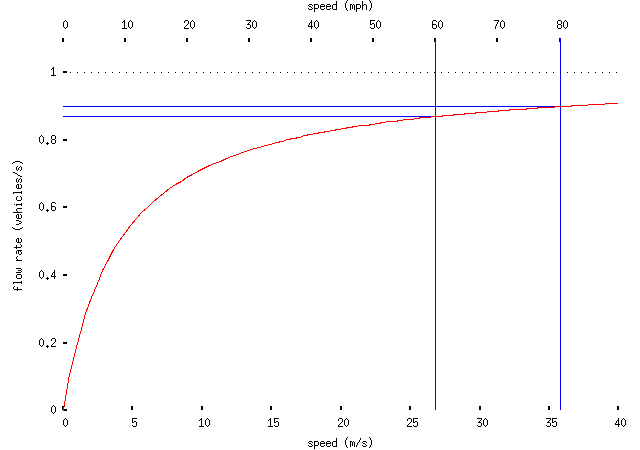
(The horizontal dotted line is the `ideal' one vehicle per second rate.)
Now, suppose that drivers, proceeding illegally along the motorway at 80mph (right vertical blue line) observe a speed camera. Keen to remain unpunished for their transgression, they break sharply, reducing their speed below the legal limit to 60mph (left vertical blue line). Once past the camera, they accelerate again.
That means that cars on the part of the road just after the camera are travelling at 60mph, and so the rate of vehicles passing through that region is smaller than that in the part before the camera -- 0.87 cars per second as against 0.90 cars per second. Cars enter the region of slow-moving traffic more quickly than they leave it, so that the region must get bigger, creating a congested stretch of road before the camera. This, we surmise, is responsible for the effect Derek Turner mentioned in last Sunday's Observer.
Well, a simple calculation based on the above numbers shows that the length of the congested stretch of road will expand at about 2.6 mph (the rate is (f(v1) - f(v2)) (v2 t + L), in case you were wondering). So, suppose that a motorway is busy for three hours during the `rush hour'; you'd expect each speed camera to be associated with a stretch of congested road of size about eight miles. In the congested region, cars travel at 60mph; outside it at 80mph. Each speed camera therefore causes a delay of approximately two minutes in each driver's journey.
This does not seem like very much to me, especially since there aren't -- so far as I understand -- all that many speed cameras on most bits of motorway.
(Of course, one can always try to put a value on this. Using the same assumptions as above, on a busy three-lane motorway, about 10,000 pass in an hour. In three hours the average traveller is delayed by one minute. Suppose that travellers' time is worth, on average, £8 per hour -- the current median wage, roughly. That means that, each rush hour, each speed camera `costs' about £1,200 in wasted travellers' time. I don't regard this as a very sensible way to look at this problem, but if somebody from the ABD wants to turn it into one of their trademark silly press releases -- if, indeed, they have not already done something similar -- I will be very amused.)
Quite independently of this, you might ask whose fault this wasted time is. But, like most `moral' discussions, that's not very likely to be productive, and in any case I've given my opinions on motorway speed limits here before.
(I should say that there are lots of other subtleties which I've ignored here, but which will, no doubt, be brought up in the comments.)

Comments
Posted by Edmund von der Burg, Thursday, 17 March 2005 07:58 (link):
I just though that I would add some observations:
Slowdowns can be caused by many things other than a speed camera. Accidents (on either side), going into rain and merging traffic all play their part.
Posted by Pete Stevens, Thursday, 17 March 2005 10:28 (link):
I think your model might not work here,
When traffic density is high and a sudden slowdown occurs on car #1, car #2 will brake sharply to avoid hitting car #1 and will brake more than car #1 did. Conseqently car #n brakes more than car #n-1 and by the power of induction at some value of n, car #n brakes so much it stops. All cars behind car #n brake and stop, and this continues backwards until the traffic density drops enough that car #n brakes less than car #n-1 at which point the normal flow will eventually recover.
See Phantom Jam.
I'm not aware of this phenomena being in dispute, certainly I've been in traffic jams with no obvious cause and there is much anecdotal evidence from motorway camera operators (flow rather than speed) that this occurs.
(It occurs to me that given this argument is well understood by quite a few people, it might be a good example to use to explain the principle of induction).
Posted by Chris Lightfoot, Thursday, 17 March 2005 12:23 (link):
Is this a question of how hard people brake, or for how long? E.g., if drivers react more quickly to the cue to start braking (brake lights of vehicle ahead come on) than to a cue to stop braking (car in front appears to start receding?) you'd get this effect even if every driver braked exactly as hard.
Posted by Pete Stevens, Thursday, 17 March 2005 13:04 (link):
As you say it doesn't matter, It's observed that for traffic density over a certain threshold,
Intgl braking dt
is larger for car #n than car #n-1
Posted by Alan Braggins, Thursday, 17 March 2005 14:32 (link):
I think it's often both. Because they are too close, they don't have time to assess exactly what the driver is doing, so as soon as they see the brakes lights of the car ahead, they brake hard,even if the driver ahead was only slowing gently. Then (at least towards the front) they realize they didn't have to brake so hard, and ease off more slowly. And the wave builds up, the cars at the back find they _did_ have to brake that hard, as the car ahead is now stationary. Where the first driver at the front is slamming his brakes on hard when he sees the camera, it's just the time difference, but in the case where the front driver just brakes gently, it does get sharper down the line too. Of course in the case where a driver doesn't brake hard enough and hits the car ahead you get a more definite congestion seed.
Posted by dsquared, Thursday, 17 March 2005 12:19 (link):
I have forgotten basically all of even the small amount of queueing theory that I learned at business school, but IIRC this would be the happy limit of the best that things could be. If you get even a bit of noise in the system (particularly biased noise, for example if people do something like brake when they see the brakelights of the car in front), then the entry and exit rates can go all over the place and you could quite easily get to a situation where there is a very material effect.
Posted by Chris Lightfoot, Thursday, 17 March 2005 12:23 (link):
"... this would be the happy limit of the best that things could be" -- yes, I'm assuming that everything is in steady state, because that makes life much easier and I was feeling lazy....
Posted by Matthew Turner, Friday, 18 March 2005 17:03 (link):
It would be wonderful if the speed cameras were to be replaced by speed governors, which presumambly prevent cars going above 70mph (or would it be 80 for foreign travel?).
The reaction of people like Clarkson, Littlejohn, the libertarian loons etc would be fantastic.
Posted by Chris Lightfoot, Friday, 18 March 2005 17:35 (link):
I think the current plan is to replace them with lots of digital cameras that read numberplates, and then fine drivers or endorse their licences based on average speed rather than point measurements. This will be cheaper and just as effective at winding up the loons various.
Posted by Colin Teubner, Friday, 18 March 2005 19:48 (link):
Do they have red-light cameras in the UK? In the US there are no speed cameras (only highway patrol lying in wait, who give chase as needed), but there are cameras that attempt to photograph license plates and sometimes drivers who enter an intersection as the light turns. As with speed cameras, these boxes are quite visible atop large poles. They're not blamed for traffic jams but have been shown to dramatically increase accidents, when some would-be light runner slams on the brakes at a yellow light and gets rear-ended by the tailgater behind her. Especially amusing is when the rear-end collision pushes the first car into the intersection, thereby (a) triggering the red-light camera anyway, and (b) causing the type of accident stoplights are meant to prevent in the first place, i.e. a side-impact collision. Of course, the revenue stream from the citations generated by the cameras is so great that none of the cities that have installed them will dream of taking them down, despite their dubious safety benefits. Usually the victim in an accident as described will receive a ticket in the mail, complete with a picture of her damaged car.
Posted by Paul Warren, Friday, 18 March 2005 20:42 (link):
The problem I see with the idea of speed governors is that I would fully expect most people to drive around as if they have a brick on the accelerator, rather than assessing a suitable speed for the road conditions. I have the same concern with the current trend towards uncapped reduction of speed limits throughout the country. In Oxford there we have recently gained a 20mph zone in the centre of town (which I understand the police have said they will not enforce) and there are campaigns to have 20mph zones extended to cover residential streets. I firmly believe that you should not being driving at any more than 20mph down most of the streets involved, but the introduction of 20mph zones underlines the idea that the things in the red circles are advisory speeds and not limits, and that it's OK to drive at 30mph down all the other streets. At the same time, in other places, you end up with speed limits that are blatently too low for the road under certain conditions, undermining respect for the limits.
Road safety campaigners need to recognise that the point of roads is transport, which involves movement of massive bodies, which involves risk. Yes, reducing speeds will reduce risks, but it will also undermine the purpose of roads, and so rationally, it can't be done indefinitely (or you end up with a lot of stationary cars).
The real question is how do you get people to drive at 20mph in a 30mph zone without putting a limit there, let alone a speed governor? I suspect the answer could be lie in an adjustment of our laughable enforcement of driving standards.
Posted by Chris Lightfoot, Saturday, 19 March 2005 00:22 (link):
I think I (roughly) agree with all of that, except for,
-- I haven't seen any decent evidence that marginal reductions in speed reduce risk, in general. It's obviously true that (e.g.) if you're hit by a car you're better off, all else being equal, being hit by one moving slowly than one moving quickly. But I haven't seen anything convincing which demonstrates that (say) traffic on a given road having mean speed (or 95th percentile speed, or whatever) 71mph will give rise to significantly fewer or less serious accidents than the same traffic at 70mph or 65mph.
(The speed-camera people have shown that speed cameras reduce vehicle speeds throughout the distribution -- in honesty, you might be surprised that that was ever in question, but whatever -- and then usually wave their hands and say ``this will give a commensurate reduction in accidents/fatalities/whatever''. But it still looks to me like an assumption, not a proven fact.)
On the other hand, as Matthew mentions above (and I've previously remarked), the idea of enforcing the traffic laws is so hilarious that it might be worth doing just for the fun of it....
Posted by Nick Vale, Saturday, 19 March 2005 08:55 (link):
Barney Oldfield (famous turn of the (last) century racing driver) was renowned for frequent accidents when not on the race track. When asked why he's said to have replied that he "couldn't concentrate properly at speeds lower than 100mph". I agree this may be an extreme case, but I think there's something to be said for experienced drivers' attention wandering more at lower speeds, thus increasing risks.
Posted by Paul Warren, Saturday, 19 March 2005 09:18 (link):
I haven't seen any decent evidence that marginal reductions in speed reduce risk, in general. It's obviously true that (e.g.) if you're hit by a car you're better off, all else being equal, being hit by one moving slowly than one moving quickly. But I haven't seen anything convincing which demonstrates that (say) traffic on a given road having mean speed (or 95th percentile speed, or whatever) 71mph will give rise to significantly fewer or less serious accidents than the same traffic at 70mph or 65mph.
Well, I wouldn't expect significantly fewer for a 1mph drop in average speed, but the correlation seems logical if hard to test. As an example (of which I have once nearly been a part), imagine motorway traffic flowing at a given rate when a cow steps out into lane 1. How does the probability of someone hitting it vary with speed? At a first approximation, assume that the only course of action is to brake.
I think the above is relatively uncontraversial, but the extrapolation to "speed cameras reduce average speed and therefore accidents" is clearly not proven.
Despite having been caught and fined, I'm actually relatively pro-camera, now that they've stopped hiding the bloody things. Not because I approve of this type of blanket speed enforcement, but because they represent a basic test of observance that a competent driver should not fail (if you can't see the big yellow box, try driving with your eyes open).
On the other hand, as Matthew mentions above (and I've previously remarked), the idea of enforcing the traffic laws is so hilarious that it might be worth doing just for the fun of it....
Possibly...
My experience of driving in the US is that broadly people do obey the limits on freeways, or rather, they exceed them by only 5mph, and I'd always assumed this came from a policy of enforcing any excess rather than the 20mph excess required to get stopped in this country. This is certainly a much more relaxing way to drive than in the UK where you have a far wider distribution of motorway speeds (say 65 to 95), but I don't know what it does to safety. Overall accident stats for the US are worse, but as ever, linking that to over-enthusiastic speed enforcement rather than the fact that all American cars are the size of a bus and allergic to corners is hard to do.
Posted by Chris Lightfoot, Saturday, 19 March 2005 11:23 (link):
Yeah. On speed versus accidents, the study I remember on this was from New Zealand. (I can't find the thing itself but this briefing prepared for the Today Programme by Prof Mervyn Stone refers to it in Appendix C.) It was convincingly demonstrated that hidden speed cameras reduce average speed, median speed, 95th percentile speed, etc. But the connection to reductions in accidents was made by assertion and not convincingly supported by the data.
To counter your cow example, consider drivers on a motorway who make some fixed journey every day. Suppose we make them slower; they spend longer on it, so the probability that (e.g.) one of them falls asleep at the wheel at some point rises. Of course, at this point we're faced with measuring the cow/sleepiness ratio and are likely to get a bit bogged down....
(Actually, motorways aren't the interesting example here; but I'm almost completely sure that reducing average speeds in towns would reduce the number of accidents there.)
Posted by Roy Badami, Sunday, 20 March 2005 16:24 (link):
My suspicion is that most tailgaters don't drive 1 second behind the car in front; they drive one car's lenght behind the car in front.
As long as people drive far too close to the car in front, it seems likely to me that reducing motorway speeds will reduce the number of accidents.
Of course, if you actually made sure people knew how to drive before letting them loose on the roads, things might be different...
Posted by Paul Warren, Monday, 21 March 2005 10:58 (link):
To counter your cow example, consider drivers on a motorway who make some fixed journey every day. Suppose we make them slower; they spend longer on it, so the probability that (e.g.) one of them falls asleep at the wheel at some point rises. Of course, at this point we're faced with measuring the cow/sleepiness ratio and are likely to get a bit bogged down....
I think falling asleep at the wheel is in the minority of accident causes for which the risk increases with decreasing speed (although the consequences don't). I would expect risk and consequences of mechanical failure to increase with speed. This is certainly the case with tyre failure. Whether it increases faster than linear (i.e. outweighs the fact that you're there for less time) I certainly can't prove, but it would be my expectation.
"I know 155mph seems excessive, officer, but I was trying to minimise my time on the motorway for safety reasons".
but I'm almost completely sure that reducing average speeds in towns would reduce the number of accidents there
Agreed, but so would stopping all cars completely. It's very easy to make the argument "we must reduce speeds because it will reduce accidents". It's much harder to make the necessary counter argument that speeds should not be reduced because roads exist because we like the benefits of being mobile, and we have to accept that there is a risk associated with that. Reducing speeds has a cost which is the erosion of that benefit.
The problem is that speed limits are a very blunt tool that can't be controlled with sufficient granularity or dynamicism to accurately dictate a "safe speed". On a journey between my house and my office (which I normally cycle), the speed limit is 30mph throughout, but the value of "maximum safe and prudent speed" typically varies between 15mph and in excess of 40mph (excluding stopping for lights etc). Does that mean we should drop the speed limit to 15mph throughout all towns?
Posted by Roy Badami, Monday, 21 March 2005 22:48 (link):
To counter your cow example, consider drivers on a motorway who make some fixed journey every day. Suppose we make them slower; they spend longer on it, so the probability that (e.g.) one of them falls asleep at the wheel at some point rises. Of course, at this point we're faced with measuring the cow/sleepiness ratio and are likely to get a bit bogged down....
Just a though, do you think if people drove slower they would really spend more time on the road? Or would they just drive fewer miles overall, and spend roughly the same amount of time on the road?
Obviously the true answer will be somewhere between these two expremes, but I suspect it may be rather closer to the latter than the former.
Posted by Chris Lightfoot, Monday, 21 March 2005 22:55 (link):
I think there's evidence that people are only prepared to spend a certain amount of time per day travelling to/from work. So if you slow down traffic people's choices of jobs will decline. But I'm clearly waffling without much to support me here, so hopefully somebody better-informed (Daniel? Matthew?) will come along and fill in the blanks.
Posted by Pete Stevens, Wednesday, 23 March 2005 00:20 (link):
Hmm, I don't have any references to hand, although given the quality of research in this field that may not be a handicap.
Things to consider are :-
Several people believe that on many roads a strongly contributing factor is the difference in speed. This is one of the justifications for the intelligent speed adaptation project which proposes using GPS to limit car speeds.[*]
The argument that some drivers are speed freaks who will avoid motorways to drive at ludicrous speed on and instead go to other single lane much more dangerous roads where they won't get caught, probably has some merit.
I don't know what fraction of accidents are caused by people in the other lane going 'Oooh, an accident' and promptly hitting each other because they are distracted. It might be more worthwhile just to build big blinds.
I have seen both sides of the argument claim that speed limiters for lorrys have doubled and halved the accident rate. I've never found the data which justifies either claim.
[*] It's worth looking up their paper for hilarities sake. It proposes that by building a BIG BILLION POUND COMPUTER SYSTEM with SATELLITES and MATHETMATICAL MODELS, they can calculate the return on investment of their project to three significant figures. That's a large UK government computing project cost predicted to closer than the number of zeros. In case you can't guess, it concludes the benefit is much bigger than the cost and it would be a *really* good idea to give them some more money.
Incidently, if you take the equations from the ISA project (ooh - equations - it *must* be true) - for risk vs speed difference & accident chance vs overall speed and apply it to the speeds for lorry drivers (all 55-56mph) with cars on the motorway (some form of distribution from about 55 - 85 mph) then depending on the exact distribution you make up, you find the most dangerous speed to drive at is about 50-55mph, and the safest is about 74mph. I'm sure there's a great paper in this if I can only find the place to submit it too.
Posted by Colin Teubner, Monday, 21 March 2005 14:41 (link):
Assuming I have more extensive driving experience in the US, I must beg to differ. First, driving habits and enforcement vary wildly from state to state here, but the most egregious enforcement tends to be in rural towns. A 2-lane highway leads into town with a speed limit of 55 mph or even 70 in some places; a mile before any sort of civilization, it suddenly drops to 35 mph and a patrol car hides behind the nearest billboard. Towns like this are able to generate a substantial revenue stream if the highway is well-travelled.
On the other hand, on large interstate highways people tend to drive at varying speeds. Usually the speed limit will be 65 mph. In the right lane you have your elderly folks driving 55 (which was formerly the national speed limit, and the elderly think the signs saying 65 are a trick). In the center lane you have moms driving minivans at 65 exactly. In the left, you have dads driving minivans at 75-80 to prove they're still macho, as well as the actually macho gentlemen driving their Ford Mustangs at 85.
Enforcement on interstates tends to be based on situation, rather than simple speeds and limits. If you are flying past a lot of traffic going 20mph over the limit, or weaving in and out (usually necessary to speed because sometimes the aforementioned minivan moms like to drive in the left lane at exactly 65mph), you are a target for being stopped. However, if everyone drives 80mph - not uncommon on certain stretches of interstate - you will need to go at least 90mph to be stopped.
One place they really do drive the speed limit is Germany. That's because when the Autobahn doesn't need a speed limit, there isn't one; the drivers there trust that whoever put up the speed limit signs (when they are there) had a good reason for doing so. Usually that reason is sharp curves, or an accident ahead, or a city, or a lane ending. To me, this seems like the best policy - dispense with speed limits unless they're necessary. For that to work in the US, we'd need to train those minivan moms out of their habit of driving in the left lane, though.
Posted by Paul Warren, Tuesday, 22 March 2005 18:56 (link):
Assuming I have more extensive driving experience in the US, I must beg to differ.
Well, my experience was based on a mere 10 days driving in California. During that time I remember several times travelling for hours at a time with the same handful of cars around me. This just doesn't happen in the UK. The majority of the traffic was travelling up to 5mph over the speed limit. Certainly travelling at 15mph over (which is pretty standard procedure on a UK motorway) would have made you stand out. I suspect that greater use of cruise control and lighter traffic also contributed to the experience.
The exception was LA - that was just like the UK, but with more lanes.
I agree with your observations about German Autobahns. One of the arguments I have against the constant cycle of speed limit reduction is the erosion of respect for the limits. A dual carriageway near Oxford recently dropped from 70mph to 50mph. Was it really 40% too fast before? My casual observation on this road is that whilst there has been a reduction in the average speed, there has been an increase in the amount by which people exceed the limit. This can only be a bad thing for people's attitude towards in-town speed limits.
Posted by Colin Teubner, Tuesday, 22 March 2005 22:32 (link):
I definitely agree with the erosion of respect for limits argument. I was driving through New Hampshire on Sunday evening (at about 75mph in a 65mph zone, faster than the general flow but not fast enough to get a ticket in this case) when the limit inexplicably dropped to 55mph. We may have been coming up on Manchester, NH - not a fact that should affect highway travel in this particular case. In any case, nobody slowed down at all, no matter the speed they'd been driving before.
California driving is somewhat different than what I'm used to, in that people speed less there and are more courteous. It's mainly on the East coast, or in, say, Chicago, where you'll be tailgated, cut off, and blown past at 20mph over the limit. I think it has something to do with the nonstop beautiful weather they enjoy out West...
Posted by Roy Badami, Saturday, 19 March 2005 21:33 (link):
What ever happened to the idea of leaving a distance between you and the car in front equal to your braking distance?
Posted by Chris Lightfoot, Saturday, 19 March 2005 21:35 (link):
Well, it doesn't seem like such a bad idea to me. But, observationally, that's not how people drive....
Posted by Roy Badami, Sunday, 20 March 2005 16:20 (link):
I guess the question I meant to ask was:
When did the highway code start recommending people drive two seconds behind the car in front of them, rather than within their stopping distance?
Certainly it was the latter when I learnt to drive. I have seen the 'two second rule' mentioned in a number of places, but I hadn't realized it had now supplanted the traditional advice in the highway code...
Posted by Chris Lightfoot, Sunday, 20 March 2005 20:14 (link):
Hmm. That is interesting.
Unaccountably, I can't find a revision history of the Code anywhere on the Department for Transport's web site and (probably for very sound reasons) they only put the current version on the web. There's a page on the Driving Standards Agency's website with the history of the Code, but I can't find any old editions on-line. I suppose this one would require an actual visit to a library....
Posted by Paul Warren, Monday, 21 March 2005 11:22 (link):
I'm not aware of any change. I've always understood:
a) Don't drive less than 2 seconds behind the car in front.
b) Don't drive so fast that you can't see your stopping distance of unobstructed road ahead of you (or at least twice that distance where there's no dividing white line)
with the car in front not counting as an obstruction because unless it all goes *horribly* wrong, it isn't going to be there when you get there.
Posted by Roy Badami, Monday, 21 March 2005 22:53 (link):
Hmm, I thought it used to tell you to leave a gap between you and the vehicle in front equal to your stopping distance. I could be misremembering, though...
Posted by Matthew, Saturday, 19 March 2005 22:34 (link):
Personally I would only allow cars to be sold if they were limited, preferably at 130kmph (to which I would raise the UK motorway limit). There's hardly any libertarian argument here, after all we have speed limits which in theory are the same thing, and not even libertarians (possibly Sean Gabb excepted) argue against them. It might be blah-blahed that you can drive them on race-tracks, or you can go to parts of Germany, but in reality how many people want to do that? 10,000? Probably less, and I'm sure a way could be found (e.g. a licence to allow an unrestricted car that was revoked for 10yrs if you were found speeding on a public road) to let them do it.
Something will have to be done as it's only going to get worse. Twenty years' ago I doubt one in ten cars could cruise above 70mph comfortably, now it's almost all, and most can do 100mph easily. Safety features partially, and drivers' reactions totally, have lagged behind.
Posted by Roy Badami, Monday, 21 March 2005 22:39 (link):
Have you seen the claims reported here that the ABD are saying the SPECS speed cameras proposed for the A14 will increase the accident rate because drivers will have to look at their speedometers?
Apparently ABD members are sufficiently unskilled that being forced to actually use the instruments in their car causes them to be unable to see even a whole army of children standing in the middle of the A14 (which, presumably, is a frequent occurrence).
Posted by Chris Lightfoot, Monday, 21 March 2005 23:03 (link):
I am shocked -- shocked! -- at evidence of incompetence and/or dishonesty by members of the ABD.
Posted by Paul Warren, Tuesday, 22 March 2005 19:17 (link):
There's certainly some pretty top-notch bollocks in that:
Most of the accidents on the A14 are not caused by speeding. They are caused by people running into the back of stationary traffic. It's just amazing ignorance that they think this will work.
Um - are they blind? Or are they going too fast? Or are there just clueless idiots behind the wheel (shock)? Whilst I suspect that dropping the speed limit would help reduce the problem, I'd much rather see the police out doing people for tailgating, and, like the Germans, for crashing.
I have a small amount of sympathy with the "cameras distract drivers" argument. I always stick to 30 limits, but I spend a lot more time with my eyes in the car near cameras - just to make sure. I used to do a regular, early Sunday morning drive along a SPECSed up bit of the Northampton ring road. Presumably, the 50 limit was, as in the A14 example, introduced to deal with the volume of rush-hour traffic. It certainly didn't make a lot of sense at 8am on a Sunday morning, and being confident of maintaining a 50mph average over a 2 mile stretch was actually quite distracting.
Posted by Roy Badami, Tuesday, 22 March 2005 23:05 (link):
Just requires practice. I am perfectly capable of maintaining my speed to within about 1 or 2 mph of my target speed... Being able to do a constant 78mph down the motorway, and being reasonably confident of not exceeding 79mph, is arguable a useful skill :-) Though more usually I'd aim to do a constant 70mph down the motorway...
It does require a degree of concentration, and it's easy for ones concetration to lapse on long journeys, but it does not require spending an inordinate amount of time staring at the speedometer...
-roy
Posted by Peter Clay, Wednesday, 30 March 2005 02:28 (link):
In my experience of the A14, I've seen risky situations (but thankfully no accidents) occuring from:
- - cars driving too close together
- - confusing road layout near Bar Hill / A418 / M11 area
- - lorries tailgaiting
- - cars and lorries pulling out suddenly to overtake the lorry they've been tailgaiting
- - poor use of sliproads
- - unexpected congestion
- - attempting to join on a sliproad only to encounter two articulated lorries driving one car-length apart (that was me; I've learnt to be very careful on sliproads)
- - tailgaiting SLK drivers
- - vehicles moving between lanes travelling at different speeds
Travelling over 70mph is usually impossible due to traffic...(The HA have a list of problems of road layout here)
Posted by Pete Stevens, Wednesday, 30 March 2005 11:47 (link):
Does anyone know what the accident statistics are for the M6 Toll road? From my trips on it, it consists of lots of people driving very quickly[*], and they have a lane each. There's no tailgaiting, congestion, driving too close, lorries and speed cameras.
I suspect the road is very safe to drive on because there is so much room, and is also one of the roads with the worst record for obeying the speed limit. This would undoubtedly irritate the 'speed kills' mob a great deal.
[*] from my trip yesterday, I'd place the slowest cars at ~70mph, most at 80-85mph and a fair few at over 100mph.
see icbirmingham The Times.
Posted by Pete Stevens, Wednesday, 30 March 2005 11:53 (link):
For what it's worth, Manchester Police seem to the the M6T is perfectly safe to drive at 100mph.
Manchester Online
(the Chief Constable was caught at 104mph in a group of about 15 cars and says 'On the day in question, the driving and road conditions were good and I was part of a group of around 15 cars all doing around the same speed. I considered that my manner of driving was safe.' - i.e. it's perfectly okay for groups of cars to drive at 100mph on an essentially clear road motorway.)
Posted by Nick Vale, Sunday, 3 April 2005 17:19 (link):
And they're right - in fact, on the right machinery at the right time of day, it's perfectly safe at 145mph (and probably more, except my R1 ran out of puff)... Unless there's a speed camera, in which case it gets very dangerous indeed (custodial sentence anyone?) Forward observation is so important. Perhaps the eventual inculcation of that discipline into otherwise braindead drivers will be an important benefit derived from speed cameras?
Posted by Steve, Monday, 4 April 2005 21:13 (link):
Indeed, the ABD et al center their argument for speed around the idea that a speeding driver is a more alert driver.
Certainly in our neck of the woods nothing could be further from the truth - the speedsters tend to also be the ones on the mobile phones, tailgating, skipping red lights etc.
The effect of cameras seems to be that these people do all that less, and obey the limits, because they're practising some basic forwards observation. Its also noticeable that the insurance companies don't offer a discount to people caught speeding - actuaries calculate premiums on masses of data, not on emotion.
Also worth mentioning that traffic noise is largely dependent on speed, and you may well think its safe to speed down a particular stretch, but have a care for someone's sleeping newborn, or quiet afternoon conversation that you're sending a roar of tyre noise to interrupt.
Post a new comment.
Comments copyright (c) contributors and available under a Creative Commons License. See also the comments policy.