I'm going away for a few days and so will leave you all with a few disconnected thoughts and whatnot. Firstly I should say that this means I have had to vote postally (I almost wrote `post votally', but to the best of my knowledge that doesn't mean anything). I have, of course, absolute faith that the Royal Mail won't lose my votes and that they will be counted for the candidates I intended to support. Beyond that it would be churlish not to wish the best of luck to the various candidates in the elections; but I'm in a churlish mood, so frankly they can all sod off, other than those I wouldn't mind seeing win.
So, on to the miscellanea. Firstly, I hadn't appreciated how similar the Conservatives' share of the vote in 1992 was to Labour's in 1997 (41.9% vs 43.2%):
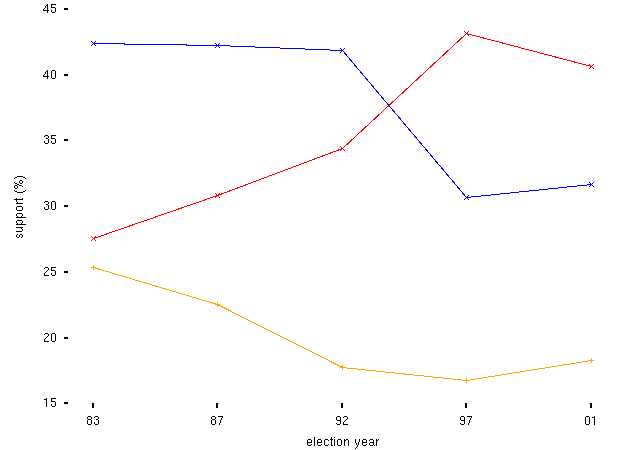
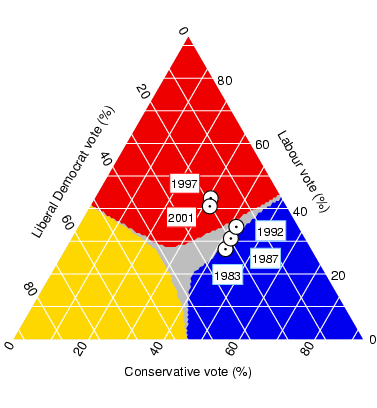
(The second of those is slightly misleading in that the coloured areas are based on the electoral geography of today; but it does illustrate that neither John Major nor Margaret Thatcher would today be guaranteed a Parliamentary majority on the shares of the votes they achieved historically.)
Moving on, a quick comment about honesty, Tony Blair, and the war (inspired partly by this rant by Conservative supporter Oliver Kamm). Whether Blair lied over Iraq is now no longer a matter of fact: it is a matter of opinion. He told the House of Commons that the sporadic and patchy intelligence evidence on Iraq's `weapons of mass destruction' was in fact `extensive, detailed and authoritative'. He said that the Attorney General's advice on the legality of the war against Iraq was `very clear' in concluding that the war was legal; in fact the document is full of caveats.
So, did Blair lie? Well, he said a number of things which were not true and which he ought to have known were not true. But did he know? Could he (for instance) have mistaken patchy and sporadic intelligence evidence for extensive, detailed and authoritative intelligence evidence? Perhaps he could.
Here is a different take on the question: is it likely that Tony Blair sat down with a book or the internet and tried to establish for himself, independently, whether the story that Iraq was making chemical and biological weapons and threatening its neighbours was really in any way plausible? My guess is no: a sad oversight on his part.
On the Political Survey 2005 front, here's a plot which should tell you something useful about how politically representative the Internet is. The coloured points on the chart are the responses of YouGov's 2,059-person sample; the black contours show the positions of the 20% (thick line) and 75% (thin line) of approximately 19,000 people who did the poll on the web:
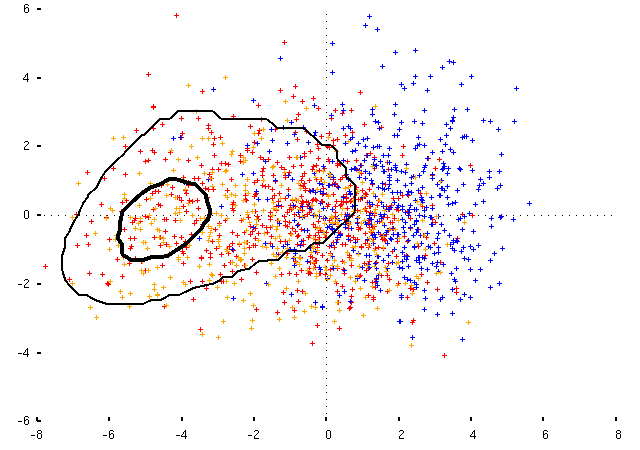
(those users found the site mostly through NTK, web logs, and the web sites of the BBC, Guardian, and The Times).
And, returning to the Election Estimation Quiz, here's an update on the relative informedness of supporters of the various political parties. A few days ago it looked as if Tories were significantly better-informed than Liberal Democrat or Labour supporters. Unfortunately this tantalisingly provocative conclusion seems to have disappeared now that we have more responses:
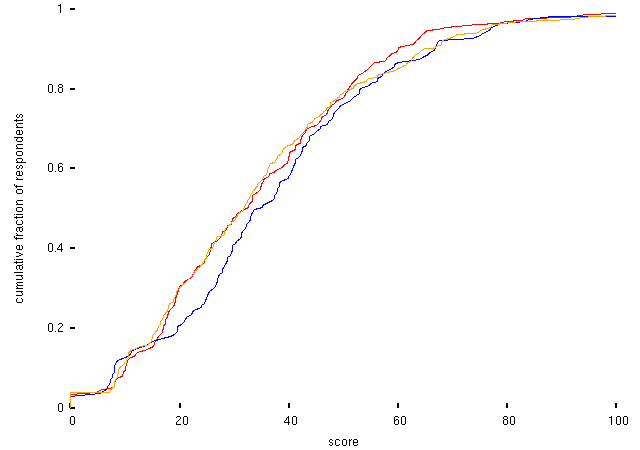
-- perhaps the Tories are doing slightly better, but any such effect is much smaller than the previous analysis suggested. This tells us, presumably, that cleverer Tories strike while the iron is hotter.
Anyway, that's all for now, because I have to get on an aeroplane in the fairly near future and I need some sleep before that happens. Happy voting, and I'll write something when I get back, assuming that the country is still here in a week's time.