So, for today's slightly eccentric data exploration, we turn to something which Marginal Revolution, an economics 'blog, quoted a little while ago:
One crude measure [of migration between US cities] is to examine the one-way rental rates for U-Haul vans.
U-Haul is a truck, van and car rental company. Their website will quote you prices for one-way trips between (I presume) any pair of US cities where they have branches. In this specific case, Andrew Roth found that the hire of a 10' truck for a journey from Los Angeles, CA to Las Vegas, NV was, at $454, almost four times as expensive as the rental for the converse trip ($119). The inference is that U-Haul adjust their pricing to demand; and that people are moving from LA to Las Vegas at a much higher rate than from Las Vegas to LA. (He wanted, I think, to make an inference about the effects of different states' marginal tax rates.)
What happens with some more data points? Well, naturally, the first thing to do is to write a scraper for the U-Haul web site; unfortunately, when they come to give you a quote for the rental you're after, the actual price is presented as a little PNG image on the web page, rather than text (this at least suggests that somebody thinks the data are valuable!); happily, they don't do it very well, so gocr can extract the numbers, more-or-less. As another tangential observation, the U-Haul website is plenty slow, but arguably that's their own stupid fault for using Microsoft `Windows'.
Anyway, considering a fairly arbitrary selection of large US cities (New York, San Francisco, Houston, Chicago, Washington DC, Detroit, Phoenix, Denver, Jacksonville, Seattle, Las Vegas and Memphis, if you must know), we get data that look like this:
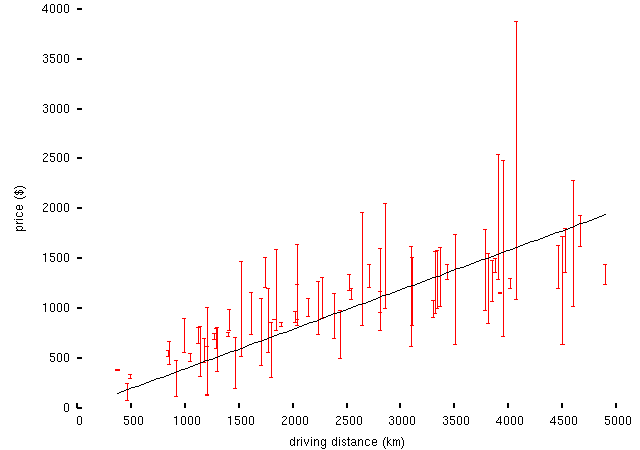
-- the vertical bars connect the prices for different directions between each pair of cities; I've used driving distances as computed by the Google Maps route planning thingy, but in fact the result isn't any cleaner than plotting the data against great-circle distances. (Though as a trivial factlet, here's driving distance vs great circle distance for the same set of cities:

-- within this sample, the US road system typically enables point-to-point travel at a ~16% penalty over the best possible route. Without seeing a comparison with other countries, it's not clear whether that means that the Americans have too few roads or too many, and anyway there are probably better ways to address this question.)
I collected these data at the beginning of September, asking for quotes for trucks available on the seventh, i.e. today. I don't know how much Hurricane Katrina will have affected this -- presumably everyone who was able and willing to evacuate did so before the storm arrived, but perhaps many people would have planned to return home around now. U-Haul presumably are in a position to adjust their prices more-or-less in real time. Of these, prices to and from Houston are most likely to have been affected.
Obviously the idea here is that if the journey from A to B costs lots more than the journey from B to A, there's a net flow from A to B. Working backwards, the assumptions have to be something like: each U-Haul outlet sees a monotonically-decreasing demand curve for journeys to each other U-Haul outlet; there is some fixed supply of trucks, and U-Haul are keen for them not to all pile up in one place; so they adjust the price for the journeys in each direction to obtain equal numbers of journeys being executed in each direction, while (hopefully) making money on each truck's round-trip. This looks sort-of plausible from the distance/price plot above; unfortunately, without knowing what the demand curves look like or what U-Haul's policies are (maybe there are some default assumptions here? dunno what they are, though), we can't get too much further.
However, we ought to be able to get some information about the relative size (in the sense of ranking rather than proportion) of the flows between different city pairs. (Except, of course, that depends on some assumptions about transitivity which probably don't hold. Ho-hum.) One important issue here is that the condition for one journey costing significantly more than its return is that the condition should be independent of distance (since otherwise the results would be biased by the distances). Though the difference between high and low prices doesn't have this property (it increases with distance) the ratio of the two prices looks more useful:
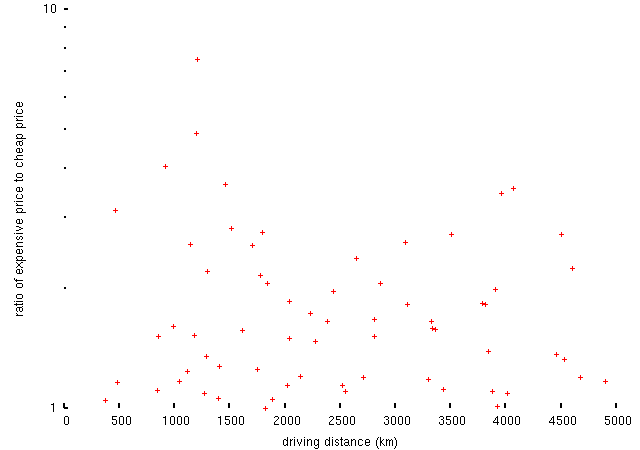
By this measure the top ten migration routes in this data set are,
... and on a map, this looks like this:
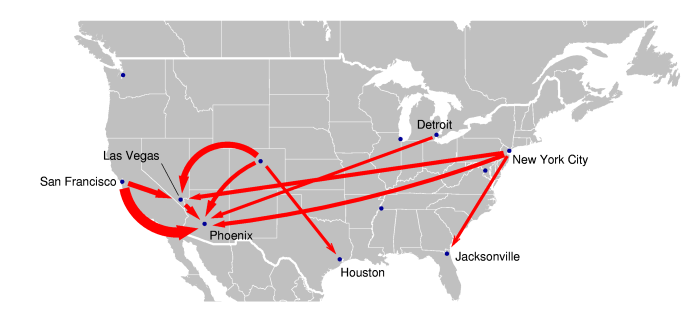
(Update: as Adam points out in the comments, I'd mixed up Detroit and Chicago on the original map. Oops. Also corrected an error in the table, above.)
(Why ten? Because with much more than that, the map gets unwieldy.)
So, what does this tell us? Specifically, it tells me not a whole lot -- beyond astonishment that people want to move to Las Vegas -- because I don't know much about the geography of the United States. (The results mostly fit the hypothesis that lots of people are running away from `rust-belt' states to get to `sun-belt' states.) But maybe some of my half-dozen readers will have something more useful to say....
(If anyone wants to play with the data, here are: prices.csv, the price data; distances.csv, the driving distances between the cities; and coords.csv, geographical coordinates of the cities. The screen-scraper is linked above.)


Comments
Posted by Roy Badami, Thursday, 8 September 2005 00:30 (link):
So Phoenix looks like a popular destination then... And lots of people want to get the hell out of SF...
Posted by Nick, Thursday, 8 September 2005 09:33 (link):
A couple of thoughts. First, Phoenix might be a popular destination right now because this is the time of the year when elderly and retired people from the northern states begin heading to the warmer south for the winter. Phoenix (and southern Arizona in general) is oe of their more popular destinations.
One thing to remember about Las Vegas is that it's the number one location for trade conventions and conferences in the US. I would suspect that a (small, but non-trivial) number of the U-Haul rentals going to Vegas will be people transporting samples, display materials, brochures etc to conventions.
I'd also hazard a guess that while looking at U-Haul numbers gives a picture of movements across the US, I would suspect it only offers a picture of people up to a certain level of income. I would expect that the use of U-Haul to move drops as income increases and people can afford to hire professional movers - from personal experience here (my brother runs a European removal company) it's quite a big step up in price from doing it yourself with a hired van to hiring professionals, so it might be interesting to compare where people are moving to at the different income levels. (Though that's probably not easy to find out)
I'd suspect, though, that people moving to Vegas are more likely to be in lower income brackets and thus more likely to be using U-Haul or similar. While Vegas is (or at least was, until recently) the fastest-growing major city in the US, the majority of the jobs there are in the service sector and low-paid and probably more likely to attract peole who would pile all their belongings in the back of a U-Haul and hit the road.
Posted by Alan Braggins, Thursday, 8 September 2005 10:23 (link):
Wouldn't most, if not all, of the U-Haul going to Las Vegas for conventions be two way, not one way? The brochures and samples might be handed out, but the displays will go back where they came from. Another thing that might affect prices related to income levels is how much U-Haul have to pay someone to redistribute trucks if there aren't enough rentals going back. The cheaper it is to hire a driver, the less incentive there is to discount a one-way trip below cost just to get the truck back. The fuel cost might make that insignificant though.
Posted by Chris Lightfoot, Thursday, 8 September 2005 19:48 (link):
Hmm... they claim 12 miles per gallon for this truck; I don't know what speed that applies to, but if it's true for (say) 50mph, then with petrol prices at ~$3/gallon in the US, the cost per hour of running the vehicle is going to be $12.50. This 2002 presentation by Michael Belzer quotes,
suggesting that fuel costs outweigh labour costs, but of course once a U-Haul employee has driven a truck from A to B, he'll presumably have to get back again somewhere and (hopefully) his employer will cover him for that. God knows how air fares are priced (they obviously vary a lot by route too), but fitting a straight line through these DoT data suggests a marginal rate of about 4¢ per mile plus a hefty fixed cost ($100+). On a multi-day journey they'll have to pay accomodation, too (tens of dollars per night?). So for a typical journey between one of these pairs of cities the cost of fuel, labour, accomodation and flying the driver back to home base are all going to be similar.The Las Vegas / conferences thing is interesting. I guess the thing to do here is to see whether the price varies much with time of booking to and from Las Vegas.
Posted by Chris Lightfoot, Thursday, 8 September 2005 20:09 (link):
-- and I've just tried this for trucks from San Francisco to Las Vegas for the six days from the 10th to 15th of September inclusive, and the quotes were exactly the same for each day! I find this astonishing -- even if they aren't adjusting the prices day by day to account for varying demand as conferences start and end, I'd have thought booking further in advance or for particular days of the week would result in
Posted by Alex, Thursday, 8 September 2005 11:18 (link):
Another factor would be the density of U-Haul branches; if San Francisco is unusually poorly served, and given that they are franchises (I think), you'd expect that ceteris paribus the price there would be bid-up.
Posted by Chris Lightfoot, Thursday, 8 September 2005 20:22 (link):
hmm. The implication of their `Dealer opportunities' page is that the individual outlets are franchises (or something like it), but the truck fleet is shared. I think that means that a particular city could only be poorly served if there weren't physically enough sites to park trucks in to satisfy demand, which seems a bit unlikely to me.
Posted by Andrew, Friday, 9 September 2005 22:27 (link):
"think that means that a particular city could only be poorly served if there weren't physically enough sites to park trucks in to satisfy demand, which seems a bit unlikely to me." No there are not physically enough sites in SF. If you go to the UHaul location near Cesar Chavez road, they do not get trucks out fast enough, it's like a parking lot every day. It's pure insanity. I think this could be part of the reason for this price, though I bet it's just poor people moving out of the city sense an apartment here costs like $2,000 a month.
Posted by Matt Daws, Thursday, 8 September 2005 16:23 (link):
Would it be possible for U Haul to use this pricing model: If city X has a net inflow of trucks to it, then increase the price of *every* one-way rental to X, until supply/demand balances it out. I haven't thought about this of very long, but can you use your data to support (or otherwise) this hypothesis? I cannot see much reason for U-Haul using this method, other than that it's easier to implement, and wouldn't seem to be (much) worse a strategy than targetting specific routes. But, if it was true, then wouldn't it undermine your analysis?
Posted by Matt Daws, Thursday, 8 September 2005 20:51 (link):
Yeah, this idea is rubbish (having looked at the figures).
Posted by andrew, Thursday, 8 September 2005 18:25 (link):
You might want to look at U-Haul rental rates for other fast growing cities. Phoenix and Vegas are doing well, and despite the "service industry" jobs in both their also becoming part of the information economy with Vegas employing hundreds if not thousands for programmers for everything from facial recognition to developing better ecnrpytion schemes for inter-casino banking. Phoenix is too, Just becuase it's not highly listed on the creativity index (example Houston, TX probably has more IT dudes in the oil sector than Austin, TX) doesn't mean it's not attracting individuals.
http://www.census.gov/Press-Release/www/releases/archives/population/005268.html
I think the real question is: are Vegas and Florida (both some of the fastest growing areas) the fastest becuase so many baby-boomers are retiring or because their both plugged into growing segments of the economy?
peace, A
Posted by Adam, Thursday, 8 September 2005 18:46 (link):
Two comments:
First, Detroit is not Chicago. Look at your map very carefully and explain why Chicago is labelled as Detroit.
Second, it only explains the movement of people who's wealth and worldy possesions fit into the UHaul renter category. Those that are more wealthy will have a company perform the move, those that are less wealthy will not need (or cannot afford) a UHaul to move.
Posted by Chris Lightfoot, Thursday, 8 September 2005 19:22 (link):
Oops! Like I said, I'm not very good on American geography! I've corrected the map. (For comparison, the price ratio for Chicago to Phoenix is 2.6.)
Sure. Also, I've used only the prices for the smallest type of U-Haul truck (10'), which is described as being suitable for moving the contents of an apartment. Possibly looking at the prices for the larger trucks might show something useful, but for these data it seems that U-Haul aren't doing anything very clever with the prices of different sized trucks:
-- specifically, a 14' truck is typically 8% more expensive than a 10' truck, a 17' 11% more expensive than a 14', and a 26' 34% more expensive than a 17'.
Posted by Karthik Ramachandran, Thursday, 8 September 2005 19:44 (link):
A suggestion...
Suppose you somehow (through RAs, operators' brothers, or magic) were to get similar price data for city-pairs for some non-U-Haul professional movers. Anecdotally, we know that people who can afford more will use these movers. If you were to represent the city pairs with highest price differential in a national map like this, say in a different color (say blue).
If you now superimpose one map on top of the other, will you be able to make broader statements about the migration of high-paying jobs between cities?
Say, for example... in the blue-plot we find that Phoenix to San Francisco is a really thick blue line (meaning a lot of richer families are moving the other way)... The natural conclusion would be to say that several high-paying jobs are moving from Phx to SFO (and the opposite for low-paying jobs). Right?
Pushing it even further, in a network of cities connected like this, any directed loop formed by thick red and blue lines will be useful to identify a sub-network of cities between which wealth is being reapportioned.
Of course, all this could be blather for any number of reasons, including the seasonality idea someone proposed.
Posted by Chris Lightfoot, Thursday, 8 September 2005 20:53 (link):
Interesting (Nick made a similar point above). I've just had a look at the Allied website, and using their `ballpark price' feature, they quote a price range of $1,270-$1,720 for a move from San Francisco to Las Vegas (2,000lb, `light' furnishings, accessible to a large truck at each end), and the same for the return journey; for Houston to Phoenix, $1,420-$1920 in either direction. That suggests that they're not using the same kind of pricing adjustment by journey as U-Haul, though it's hardly conclusive, since they could be quoting an approximate price based on distance only and only revealing the actual price if you commit to getting a real quote. Equally (and I think more likely) the $500 range could reflect how long it takes to load/unload personal effects from different homes.
Posted by Craig Beck, Friday, 9 September 2005 22:17 (link):
I'm thinking the professional moviing companies employ people to move/drive your stuff across the country and they would be making a round trip back to their home -- so it's not quite the same as a driverless fleet of trucks being shuffled around the country on lots of one-way trips. This could account for similar pricing in both directions as each move is a paid round trip -- once out with your stuff and an empty load back. Granted, Allied etc could try to book loads going the other way, but you would have to know more about their business model etc... My parents used the same moving guy (Allied, I think) in moves from PA to CA, CA to CT, CT to PA etc.. so I'm not sure how they actually run things i.e. independant contractors, franchieses, corporate monolith or whatever...
Posted by dsquared, Thursday, 8 September 2005 20:22 (link):
I've haphazardly looked around the net to see whether the explanation might be something as prosaic as every state except Nevada and Arizona charging a sales tax on U-Haul rentals, but no luck. Any American sales tax experts out there?
Posted by Chris Lightfoot, Thursday, 8 September 2005 20:29 (link):
ha! Wouldn't that be the perfect explanation! The quotes don't include sales (or rental) tax, but of course it's possible that they're adjusting their rates to compensate for the effects of tax in some way.
Aren't sales taxes in the US typically payable only in the state of purchase? I vaguely remember something like that from a discussion of sales tax and e-commerce....
Posted by Matt Daws, Thursday, 8 September 2005 20:52 (link):
Wouldn't this also be shot down in the same manner as my idea (see above) was? That is, if the variation was down to sales tax charge in the origin state, shouldn't we see a correlation between starting location and price increase? However, that doesn't exist...
Posted by Dan, Friday, 9 September 2005 03:17 (link):
One thing you may want to consider (and I don't see any mention of) is the drastically varying cost of living between the respective pairs of cities. For example, the CoL between San Francisco and Phoenix is roughly 2:1. My gut feeling is that will eliminate some of the disparity between what you've seen and other measurements of this type.
The homefair.com Cost Of Living Calculator looks like it might be easy to scrape for this purpose, or I'm sure it's available as a table somewhere.
Posted by Chris Lightfoot, Monday, 12 September 2005 23:30 (link):
Interesting. I tried with some data from this table (possibly not the best choice, since the source isn't cited, but it's in a convenient format). Basically, if you do a regression for price of the journey between two cities as a function of cost of living in the two cities and the distance between them, you get a reasonable fit but the residuals are pretty huge (comparable to those if you regress against distance only) so I'm not sure this is a useful approach.
Posted by W.E. Howard, Friday, 9 September 2005 03:20 (link):
Consider the idea that U-Haul needs many more trucks in LA than in LV. Therefore, they offer an incentive for moving trucks to LA, and a disincentive for moving trucks to L V.
Posted by Chris Lightfoot, Monday, 12 September 2005 21:50 (link):
Yeah. So that becomes important if demand in the local market (i.e. for intra-town moves) is very variable, so that the operator has to redistribute their fleet to cope with that kind of demand all the time. I guess the way to approach this would be to measure the changes in price for intra-town rentals as well, then fit some model to pick out the part of the variability in the inter-town prices which is driven by the local variability. Or something like that.
Intuitively it doesn't seem to me like this'd be a big effect, since presumably each town will generate a certain number of rentals per day (related to its size, activity in the property market, ...) with some Poisson variability, so the vendor is unlikely to see big swings in local demand. But that's just a guess....
Posted by Colin Teubner, Friday, 9 September 2005 15:27 (link):
Something you haven't considered (and probably couldn't have known) is how U-Haul relates to its competitors in terms of service quality. U-Haul is far and away the worst, most awful company to deal with in any industry. They routinely discard reservations and deny they ever existed; demand a vehicle's return before the reserved time; raise rates when you arrive to collect your van; and other things of that nature. Hence anyone who is doing their second do-it-yourself move is more likely to rent from a U-Haul competitor (e.g. Ryder, Budget, Penske).
I doubt there's much to the theory of conventions having an effect in Vegas - companies don't tend to drive their own stuff to conventions. They ship it using FedEx or a freight service and then fly there. Likewise, people are moving to Phoenix for the same reason they're moving to Vegas - it's in the middle of the desert and there's tons of cheap, empty land there for building gigantic houses (miles from anything worthwhile.) The elderly are NOT renting U-Hauls.
Finally, since we know New York is still growing in size (though San Francisco proper, but not its metro area, is shrinking), I think the moves from those places to the desert reflect people in a certain stage of life tending to move there, rather than the population at large. I think there's a vague pattern in which people graduate high school and/or college, move into a 'young' city like NY, SF, Boston or Chicago (using mom's station wagon, since they don't yet have enough stuff to need a truck), buy furniture, get married, have babies, and then move to the desert so they have space for all the crap and babies they've accumulated.
Posted by Chris Lightfoot, Monday, 12 September 2005 21:45 (link):
and I think lots of the outliers there can be explained by the fact that we're comparing quotes from different days. The fact that the two lots of prices are comparable is promising, since that's what ought to happen in a reasonably competitive market assuming that the prices aren't being driven by the local setup of each operator.
Yeah, that makes sense. Of course, without more data about who uses what kind of service to move, it's not possible to get much further with this....Posted by john b, Monday, 12 September 2005 23:23 (link):
Americans, mercifully for them, are saved the tribulations of dealing with NTL. It only operates in the UK (and possibly Ireland, depending on whether or not it's already found some dupe to buy its woeful Irish operations...)
Posted by Chris Lightfoot, Tuesday, 13 September 2005 09:54 (link):
The lucky bastards.
Posted by Andrew, Friday, 9 September 2005 22:23 (link):
"Another factor would be the density of U-Haul branches; if San Francisco is unusually poorly served, and given that they are franchises (I think), you'd expect that ceteris paribus the price there would be bid-up."
I want to speak from (recent) experience, that SF is poorly served by UHaul locations, and that they cannot move trucks out as fast as they'd like.
Posted by Alex, Monday, 12 September 2005 16:32 (link):
Another question would be the demand for short-distance transport; if the short-haul demand in city X exceeds the long-haul demand to city X, it would make sense to cut the long-haul rates in order to ensure enough trucks were available to meet the short-haul demand.
Post a new comment.
Comments copyright (c) contributors and available under a Creative Commons License. See also the comments policy.