OK, that's enough of that. I was impressed that two people got the right answer (Tom wasn't far off, either). Here's a labelled map:
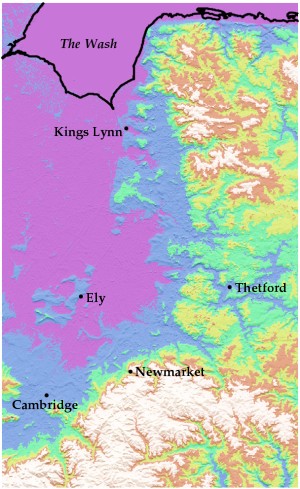
and one with slightly more conventional colouring:
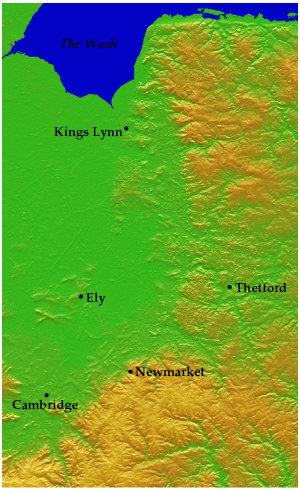
The data come, incidentally, from the Shuttle RADAR Topography Mission, which, pace Maciej Ceglowski, is one of very few useful things that've been done with the shuttle. The reason I was looking at this in the first place was equally as silly as the map itself. I remember being told years ago something like,
if you draw a line eastwards from the top of Castle Hill in Cambridge, the first time it crosses higher ground is when it reaches the Urals
-- this theory being advanced as explanation for Cambridge's lousy winter weather. It's nonsense, of course, topographically and meteorologically. That didn't stop me wondering what the actual topographic profile looks like. Here it is:
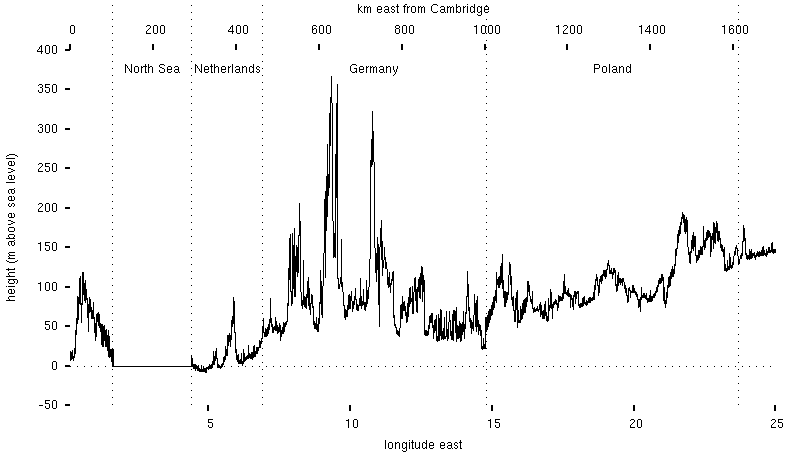
The Urals lie a further two thousand or so kilometers to the east.


Comments
Posted by Simstim, Thursday, 5 January 2006 22:36 (link):
Just the coastline would have enabled me to get it, without the coastline the possibilities were increased rather significantly. Slightly embarrassing as my family come from St. Ives/Huntingdon AND I've cycle-toured the area, although I do have the excuse that the latter predisposes one against seeing the highest hills in East Anglia as worthy of white altitude colouring.
Posted by Alex, Friday, 6 January 2006 00:02 (link):
Regarding the Urals, the same meme circulates in Bradford with regard to Odsal Top. Given the extra altitude and (more importantly) the extra northing, which gives a great circle route over the North German Plain rather than the Harzgebirge, that one might even be right.
Posted by Liz Upton, Friday, 6 January 2006 11:01 (link):
Interesting you should say that - the same meme (in an even dafter format) also circulates in Grimsby, where they say if you stand at the top of the church tower,there will be nothing between you and the North Pole.
I'm sure Pooh Bear would have a thing or two to say about that.
Posted by Chris Lightfoot, Friday, 6 January 2006 17:19 (link):
Actually, this one appears to be true, if it means ``there is no higher ground between ...''. There's no land between Grimsby and the North Pole other than the other bank of the Humber:
and there's not much high ground there, at least according to the SRTM data:
So, as long as the church tower of St James' is more than nine meters high, there is indeed nothing higher between there and the North Pole.
One caveat: I don't know how accurate the SRTM data are in built-up areas; a brief Google indicates that (as you'd expect) the RADAR picks up buildings pretty well, but looking at the map of Grimsby it appears that the church is at least above the 5m contour, so I don't think the 7m SRTM gives is too unreasonable.
Posted by Liz Upton, Saturday, 7 January 2006 12:59 (link):
Embarrassingly, I'd always assumed that this was just something my Grandma was telling me to shut me up when I complained about being cold. My mother reports that her childhood saw actual icebergs floating up to the beach in Cleethorpes (next town along the coast). We learn something from all this, though: don't move to Grimsby.
Posted by Arnold, Wednesday, 25 January 2006 22:45 (link):
You may be interested to know that the legend goes back nearly a hundred years; here it is in "Cambridgeshire" by T. McKenny Hughes (Cambridge University Press, 1909): 'The highest point of the Gog-Magogs near Cambridge is just over 300 feet, though in the south-east of the county the ground rises to about 400 feet. This is the greatest height about sea-level which we shall find in Cambridgeshire. To the native of a mountainous country our hills are mere rising ground, but everything is relative, and they are our Alps, which raise us above the plain into the purer air, with nothing higher, eastwards, between us and the Ural Mountains.' The author was Woodwardian Professor of Geology, so I had always assumed he must know what he was talking about, but perhaps not.
Posted by Liz Upton, Sunday, 29 January 2006 13:37 (link):
There seems to be a fair old amount of confusion about the Gog Magogs. This fellow seems to believe that they're the site where Troy was once upon a time, although it should be noted that his only evidence for the claim is from a bit of Ovid which reads: Now there are fields where Troy once stood!'
Compelling indeed.
I live at one end of the Devil's Dyke, which this guy has being used in antiquity as a sort of bridleway for chariots bearing down on Troy. I note that a) you couldn't fit a chariot on top of they dyke even with a degree of squeezing and use of rear-view mirrors, and b) the dyke runs from Reach towards Newmarket, and nowhere near the Gog Magogs.
Post a new comment.
Comments copyright (c) contributors and available under a Creative Commons License. See also the comments policy.